Project: Generative Modeling of Pedestrian Crowds
Description
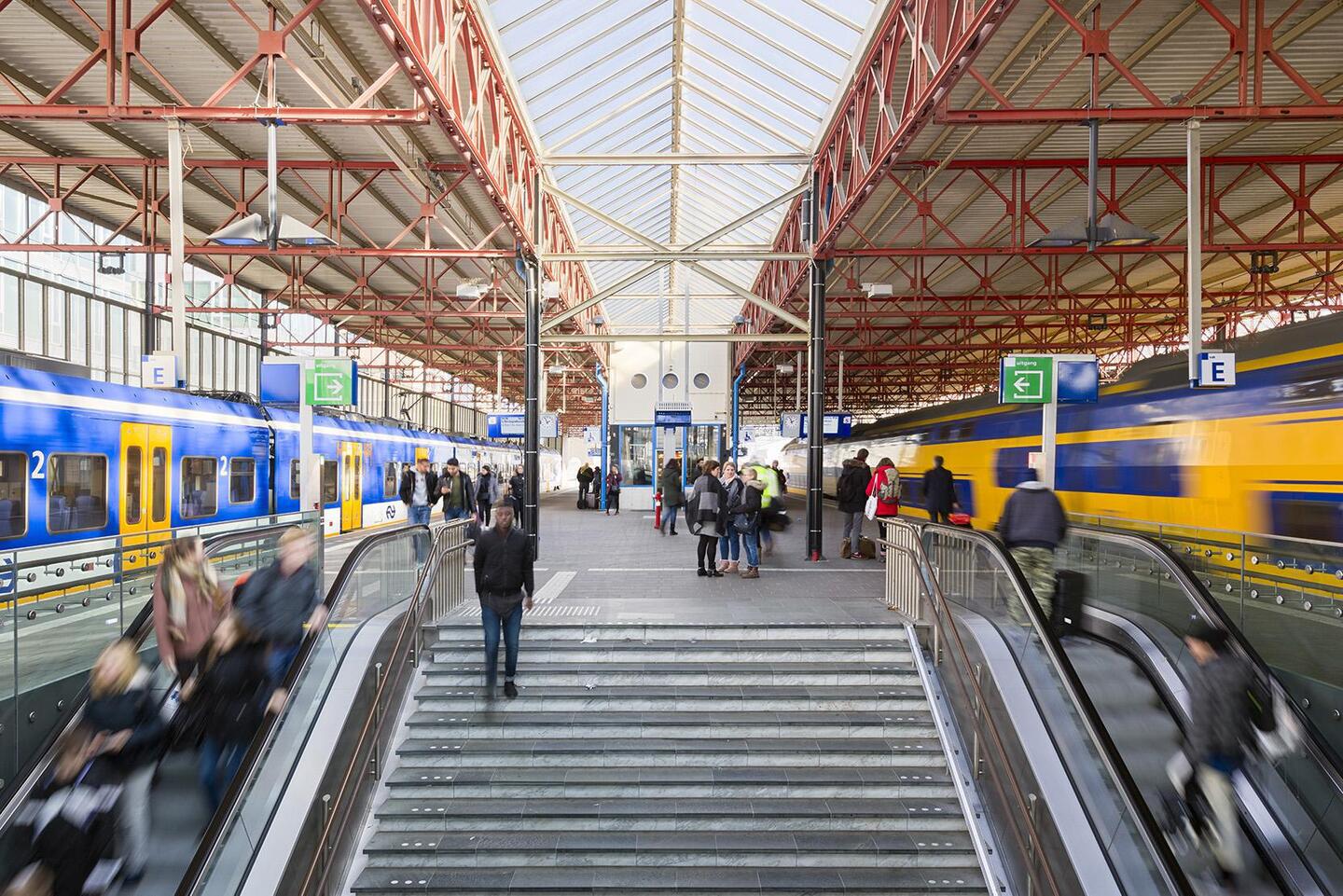
Every day, millions of people pass through train stations, squeezing past each other on platforms, flowing around pillars and heading for the right exit. Understanding how crowds move matters for designing safer, more comfortable public spaces. It is also an interesting puzzle: crowds are stochastic many-body systems shaped by individual intent, social interaction and the surrounding environment, and classical models struggle to capture all of this at once.
Generative machine learning opens a new route. By learning dynamics directly from real trajectories, a model can produce many plausible futures. Once it is accurate enough, it becomes a data-driven simulator that lets us ask "what if?": what happens when we move an obstacle, close an exit or double the crowd?
STFlow is a state-of-the-art generative framework for trajectory simulation. It builds on flow matching and starts generation from an informed prior derived from each agent's observed motion, which makes it fast, scalable and accurate across physical, molecular and human motion data. Its current view of a pedestrian, however, is limited to where they have been. Real pedestrians are also driven by where they want to go and shaped by the space around them.
This project explores the following question: How can existing modern generative models be extended with environment and goal-based conditioning, and what does this bring in terms of realism, statistical fidelity and controllability of simulated crowds?
Project starts around Q3 2026-2027
Research directions and possible techniques
You will work with unique real-world data: trajectories of millions of pedestrians recorded at several large train stations in the Netherlands. It offers a real chance to test how far generative crowd modelling can go.
On the environment side, a central question is how to represent space so the model can reason about it. Options range from treating obstacles and boundaries as additional entities in the interaction graph, to continuous geometric descriptions such as distance fields, to learned scene encodings that agents attend to.
On the goal side, the question is how intent should shape generation. One direction uses the framework's flexible conditioning to fix destinations or waypoints. Another builds goal-awareness into the prior itself, so that generation starts from motion already heading somewhere sensible. Guidance techniques could tune how strongly goals steer the result, and latent intent variables could capture the uncertainty in where people are heading.
The project will be in close collaboration with the AI for Complex and Traffic Flows group from the Department of Applied Physics, who bring deep expertise in the physics of human crowds. Their domain knowledge makes an extensive evaluation and benchmarking setup possible. Beyond prediction error, you will be able to test whether simulated crowds truly behave like real ones, in their fundamental diagrams, avoidance behavior and response to changes in the environment. You will be working at the intersection of modern generative AI and real-world physics, with results that could make a tangible impact.
Relevant Literature:
- STFlow: Data-Coupled Flow Matching for Geometric Trajectory Simulation
- Discovering interaction mechanisms in crowds via deep generative surrogate experiments
- Flow Matching Guide and Code
- Stochastic interpolants with data-dependent couplings
Details
- Supervisor
-
 Vlado Menkovski
- Secondary supervisor
-
 Kiet Bennema ten Brinke
- Interested?
- Get in contact