Project: (External: PwC) Optimization and Pareto fronts in the Responsible Business Simulator
Description
Introduction
In the current business landscape, companies are balancing profitability and social responsibility. The Responsible Business Simulator (RBS) is a powerful tool designed by PwC to help businesses make responsible strategic choices by simulating the impact of various decisions on diverse outputs. This master's thesis project focuses on further developing the RBS to enable more advanced simulations and optimizations.
Project Objectives
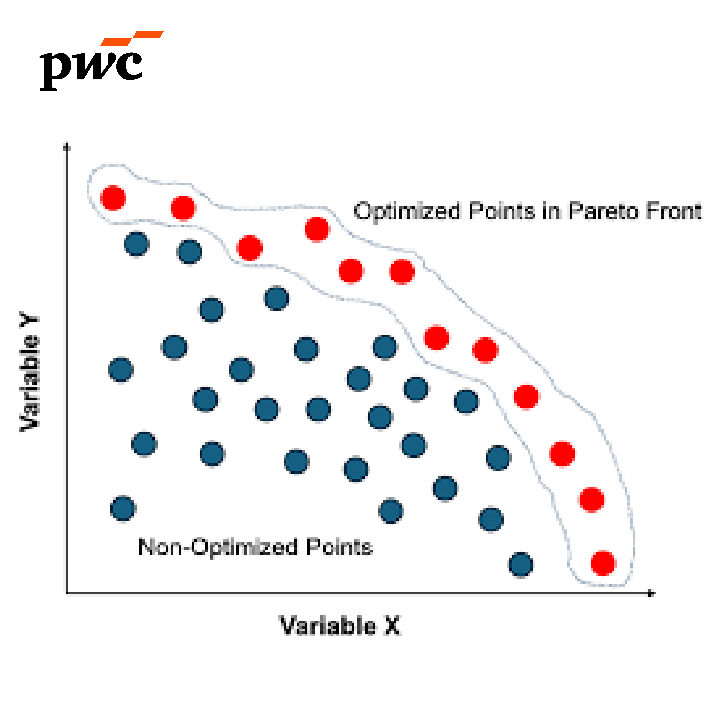
The main objective of this project is to expand the functionalities of the RBS by integrating more refined analysis tools and optimization methods. Specifically, improving the way the simulator generates Pareto fronts and reviewing current optimization methods are key focus areas. This provides business users with the insights needed to compare strategic decisions and determine if options qualify as "game changers."
Current Challenges and Opportunities
The existing RBS uses a simple grid search technique for optimization, which is limited in efficiency and scalability. There is a clear need to implement more advanced optimization algorithms, such as Lipschitz-based methods, which can potentially offer more robust and flexible solutions. Additionally, the specific domain-oriented characteristics of the current solvers need to be evaluated and expanded to allow broader application across different sectors.
Research Components
1. Pareto Front Generation: The project will investigate how different methods can be applied to generate Pareto fronts and present them in the RBS interface. Various methods will be compared to determine which are most effective in exposing trade-offs between competing strategic options.
2. Optimization Methods: In addition to the existing grid search, the project will consider more advanced methods such as Lipschitz-continuous optimization and other advanced approaches. The potential of these methods to overcome domain-specific constraints and offer more universal applicability will be explored.
Expected Results and Contributions
This project will result in an improved version of the RBS that supports decision makers in making informed strategic choices that take both social and economic impacts into account. By introducing refined optimization techniques and more robust analysis tools, the simulator will enable users to analyze more complex scenarios and make better-informed decisions.
Conclusion
The ongoing development of the Responsible Business Simulator is central to this master's thesis project. By integrating innovative analysis methods and optimization techniques, the project will contribute to supporting responsible business practices. This will not only help companies achieve their strategic goals but also have a positive impact on society and the environment.
Student Profile
- The project requires proficiency in Python and Git. Experience in both is a strong advantage.
- The candidate is an aspiring data analytics consultant.
References
More information about the Responsible Business Simulator, a GitHub link, and a Jupyter Notebook example can be found at: https://www.pwc.nl/en/topics/digital/data-analytics/responsible-business-simulator.html
Also, check out the book on the Responsible Business Simulator:
Roobeek, A., De Swart, J., & Van Der Plas, M. (2018). Responsible Business: Making Strategic Decisions to Benefit People, the Planet and Profits. Kogan Page Publishers.
Details
- Supervisor
-
 Bart Engelen
- External location
- PwC
- Interested?
- Get in contact