Project: A Study on Decomposition-Based Forecasting Models: Does Time Series Decomposition really Help?
Description
Background & Motivation
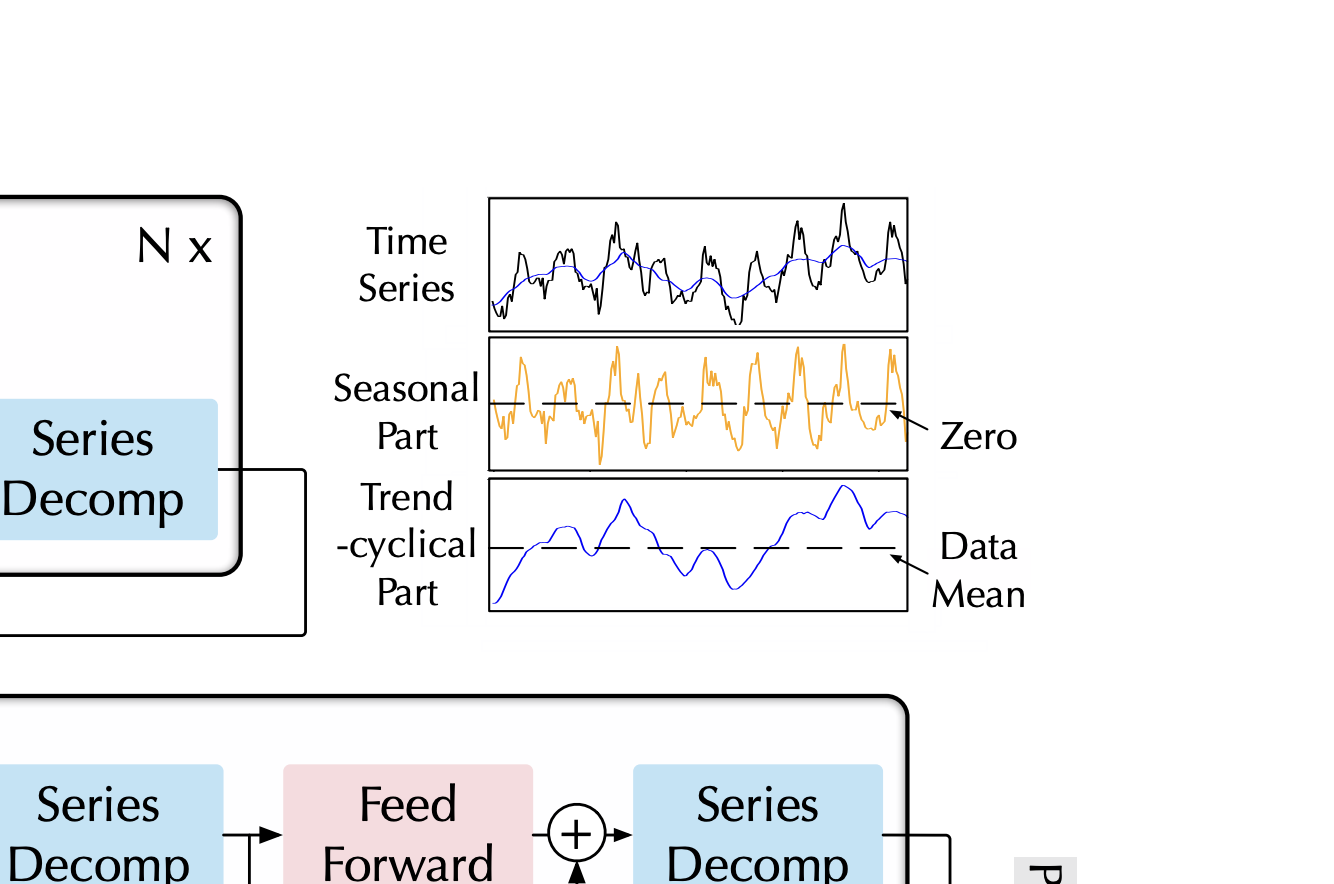
Many recent time series forecasting models (e.g., ETSformer[1], Autoformer[2], FEDformer[3], SCINet[4], DLinear [5]) incorporate series decomposition into trend and seasonal components before prediction. The intuition is that separating these underlying patterns makes forecasting easier and more accurate.
However, decomposition does not always help — and might even hurt performance — depending on: the dataset, the type of non-stationarity, or how decomposition is integrated into the model.
Despite its popularity, there is limited systematic analysis of when decomposition is useful and why.
Objective
This project aims to:
1. Analyze and categorize decomposition techniques used in forecasting models (e.g., moving average, Fourier, learnable filters).
2. Benchmark performance of decomposition-based vs. non-decomposition models across various datasets and non-stationary scenarios.
3. Identify factors (e.g., seasonal strength, trend shifts) that influence the usefulness of decomposition.
4. Optionally, propose a modified version of an existing approach to better utilize decomposition based on time series characteristics.
Students with experience in time series forecasting and a strong interest in research are encouraged to apply. This project has the potential to a publication.
[1] Woo, Gerald, et al. "Etsformer: Exponential smoothing transformers for time-series forecasting." arXiv preprint arXiv:2202.01381 (2022).
[2] Wu, Haixu, et al. "Autoformer: Decomposition transformers with auto-correlation for long-term series forecasting." Advances in neural information processing systems 34 (2021): 22419-22430.
[3] Zhou, Tian, et al. "Fedformer: Frequency enhanced decomposed transformer for long-term series forecasting." International conference on machine learning. PMLR, 2022.
[4] Liu, Minhao, et al. "Scinet: Time series modeling and forecasting with sample convolution and interaction." Advances in Neural Information Processing Systems 35 (2022): 5816-5828.
[5] Zeng, Ailing, et al. "Are transformers effective for time series forecasting?." Proceedings of the AAAI conference on artificial intelligence. Vol. 37. No. 9. 2023.
Details
- Supervisor
-
 Amy Deng
- Interested?
- Get in contact