Project: A Study of Non-Stationary Time Series Forecasting: Analysis, Limitations, and a New Adaptive Framework
Description
Background & Motivation
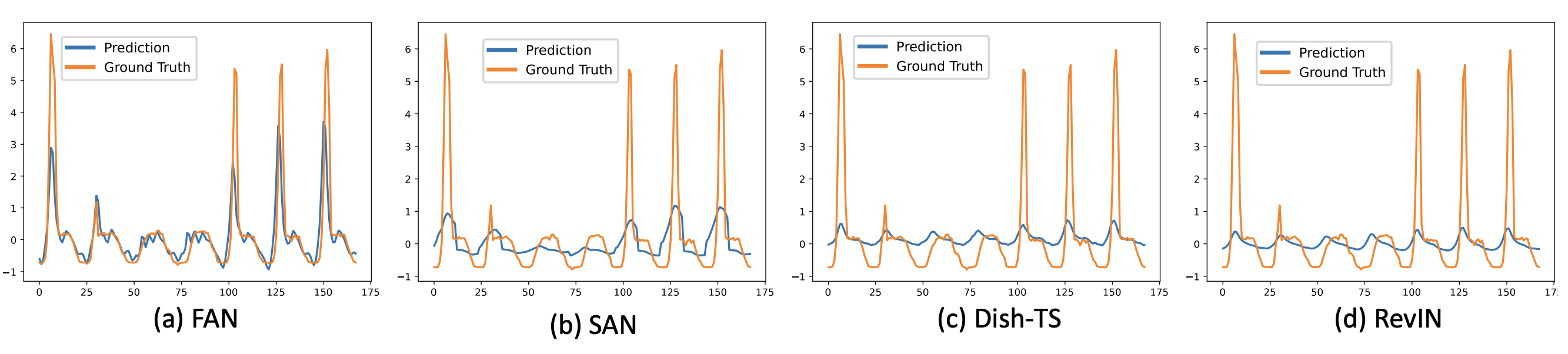
Real-world time series often exhibit non-stationarity, where statistical properties such as mean, variance, or seasonal structure evolve over time. This poses a major challenge for accurate and robust forecasting. Recent methods like RevIN (Reversible Instance Normalization) [1], SAN (Slicing Adaptive Normalization) [2], FAN (Frequency Adaptive Normalization) [3], and Dish-TS [4]have been proposed to handle this issue by employing different normalization or decomposition strategies. The code for most methods are open-sourced/standarized and easy to implement.
However, a comprehensive understanding of how, when, and why these methods work (or fail) is lacking. Moreover, existing approaches tend to rely on fixed assumptions and may not generalize well across different datasets or domains.
Objective
1. Systematically evaluate leading non-stationarity handling methods (RevIN, FAN, SAN, Dish-TS) across diverse time series forecasting tasks. 2. Analyze their assumptions, strengths, and limitations. 3. Propose a novel adaptive framework that combines the strengths of these methods and dynamically adjusts to different non-stationary patterns in data.
Expected Contributions
A clear comparative understanding of current non-stationarity handling techniques, e.g., when current methods succeed and fail. A new adaptive module that improves performance under dynamic data regimes.
Students with experience in time series forecasting and a strong interest in research are encouraged to apply. This project has the potential to a publication.
[1] Kim, Taesung, et al. "Reversible instance normalization for accurate time-series forecasting against distribution shift." International conference on learning representations. 2021.
[2] Liu, Zhiding, et al. "Adaptive normalization for non-stationary time series forecasting: A temporal slice perspective." Advances in Neural Information Processing Systems 36 (2023): 14273-14292.
[3] Ye, Weiwei, et al. "Frequency Adaptive Normalization For Non-stationary Time Series Forecasting." arXiv preprint arXiv:2409.20371 (2024).
[4] Fan, Wei, et al. "Dish-ts: a general paradigm for alleviating distribution shift in time series forecasting." Proceedings of the AAAI conference on artificial intelligence. Vol. 37. No. 6. 2023.
Details
- Supervisor
-
 Amy Deng
- Interested?
- Get in contact