Project: Nuclear fusion: Coupling 1D and 2D simulation of Tokamk Plasmas with deep generative models (TAKEN)
Description
[For this project there is a possibility for a 6 months internship at DIFFER (Dutch Institute for Fundamental Energy Research) located at the TU/e campus in Eindhoven. The internship is planned after the preparation phase of the graduation project conditioned on the results achieved in that period.]
Fusion energy has been a promising area of research for decades due to its potential to provide a nearly limitless clean energy. However, one of the critical challenges in fusion research is managing the interaction between the plasma and the reactor walls, which can cause significant material erosion and performance degradation [1]. Tokamaks, one of the most advanced fusion devices, are
designed to contain and stabilize high-temperature plasmas necessary for fusion reactions. One key component of the Tokamak is the divertor, which directs excess heat and particles away from the core plasma, protecting the walls of the reactor. Accurately predicting the behavior and trajectory of plasma to the divertor target is crucial for optimizing plasma control and improving divertor design.
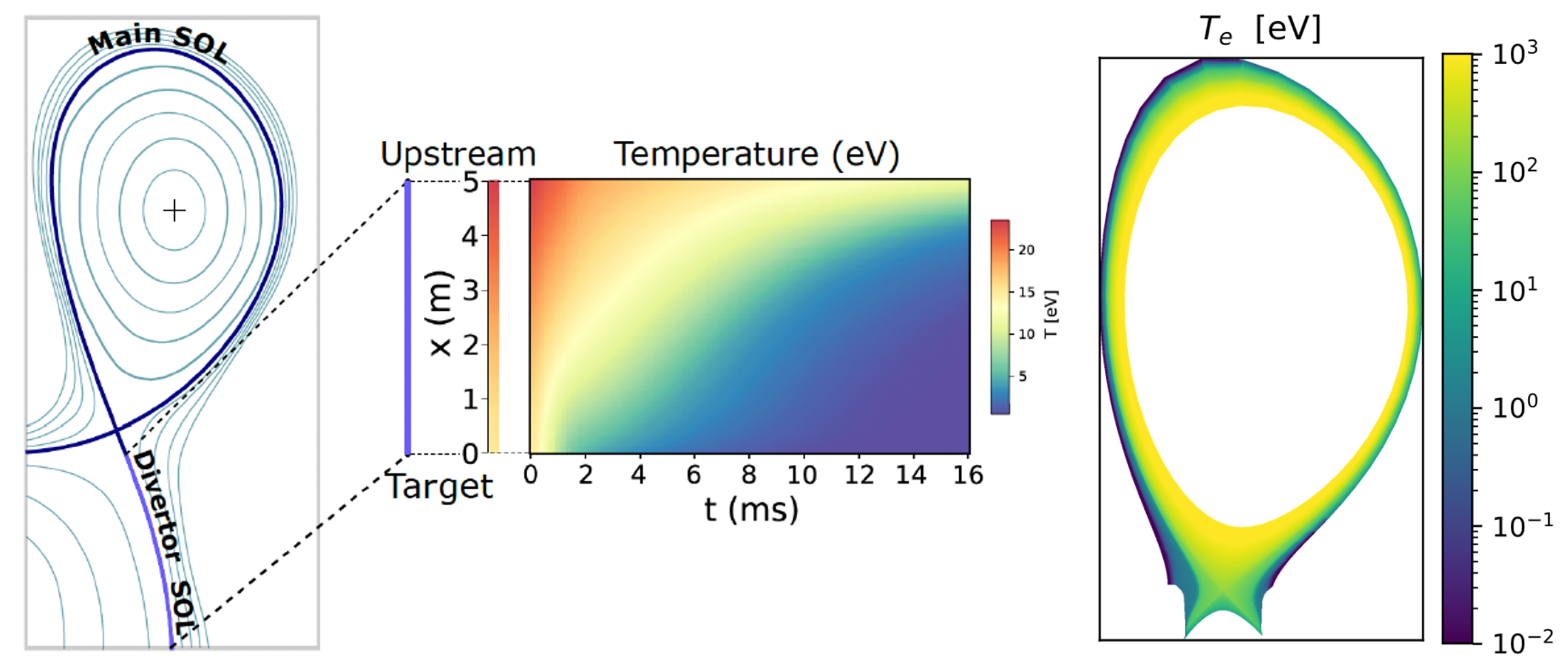
The region of interest for power exhaust is called the Scrape-off Layer (SOL) and is defined as the region between the core plasma and the reactor wall. Simulations play a vital role in understanding the dynamics in this region which is dependent on many physical processes and as such depends on expensive simulations of coupled PDE systems. In recent years, models based on machine learning have shown great potential in accelerating plasma simulations by learning from large datasets [2]. For the SOL specifically, surrogates have been developed for either the full two dimensional spatial solution in steady state [3] or for simplified time dynamics in the one dimensional divertor leg [4].
The goal of this project is to investigate ways of incorporating the one dimensional time dynamics of DIV1D simulations [5] to generate full two dimensional time dependent changes of the scrape-off layer plasma.
Available data will consists of DIV1D dynamics simulations and the corresponding two dimensional steady state profiles for a range of simulations for the Swiss tokamak á configuration variable (TCV).
[1] R. A. Pitts et al. Physics basis for the first ITER tungsten divertor. Nucl. Mater. Energy, 20(July):100696, 2019
[2] Wiesen, Sven, et al. "Data-driven models in fusion exhaust: AI methods and perspectives." Nuclear Fusion 64.8 (2024): 086046.
[3] Dasbach, Stefan, and Sven Wiesen. "Towards fast surrogate models for interpolation of tokamak edge plasmas." Nuclear materials and energy 34 (2023): 101396.
[4] Y. Poels et al., “Fast dynamic 1D simulation of divertor plasmas with neural PDE surrogates,” Nuclear Fusion, vol. 63, no. 12, p. 126012, 2023.
[5] G. Derks et al. Multi-machine benchmark of the self-consistent 1d scrape-off layer model DIV1D from stagnation point to target with SOLPS-ITER. Plasma Physics and Controlled Fusion, 6(5):055004,
2024.
Details
- Student
-
GGGabriele Gianuzzo
- Supervisor
-
 Vlado Menkovski
- External location
- TU/e + DIFFER
- Interested?
- Get in contact